Choosing between epoxy and urethane coatings for Florida properties requires understanding how each performs under intense UV exposure, high humidity, and extreme heat. While epoxy offers superior hardness and chemical resistance, urethane excels in UV stability and abrasion resistance—critical factors for South Florida’s challenging climate. National Concrete Polishing helps property owners select the optimal coating system based on location, usage, and environmental exposure to maximize floor longevity and performance.
Overview
This comprehensive guide compares epoxy and urethane floor coatings specifically for Florida applications. You’ll learn about durability differences, climate performance, UV resistance, curing times, and ideal use cases for each coating type. We’ll also explore hybrid solutions that combine the strengths of both systems for superior results in South Florida’s demanding environment.
Key Takeaways
- Urethane coatings offer 4x better abrasion resistance and superior UV stability compared to epoxy
- Epoxy provides harder surfaces with better chemical resistance and substrate bonding
- Florida’s UV exposure causes epoxy yellowing and degradation without proper topcoats
- Urethane cures faster (overnight vs 7 days) but requires more installation expertise
- Hybrid systems using epoxy base with urethane topcoat deliver optimal Florida performance
- Climate-specific product selection prevents premature failure in humid conditions
- Professional installation ensures proper coating choice for your specific application
Understanding Epoxy Coatings
Epoxy floor coatings create an exceptionally hard, durable surface through chemical bonding with concrete substrates. These two-component systems combine resin and hardener to form a rigid, impact-resistant floor that excels in industrial environments with heavy machinery and chemical exposure. Epoxy’s superior compression strength makes it the preferred choice for warehouses, manufacturing facilities, and logistics centers with constant forklift traffic.
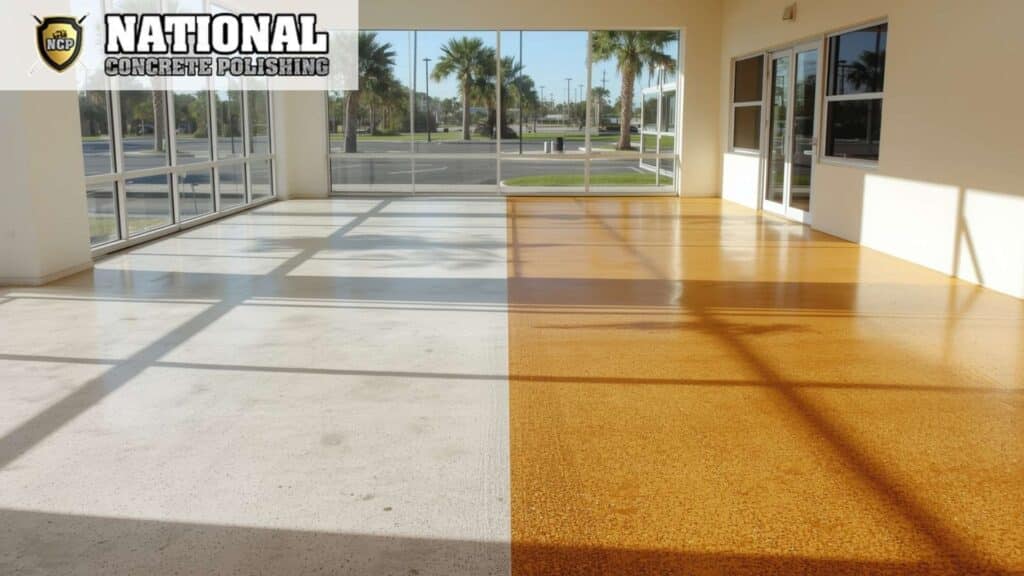
The coating bonds directly to concrete, allowing for buildable thickness that enhances durability and longevity. Commercial epoxy applications benefit from this strong substrate adhesion, creating seamless surfaces that withstand decades of heavy use. However, epoxy’s rigidity also creates vulnerabilities in certain environments, particularly outdoor or high-UV locations.
Understanding Urethane Coatings
Urethane floor coatings are elastic, flexible systems that prioritize abrasion resistance and UV stability over hardness. These coatings typically apply as thin films (2-3 mils) at 350-500 square feet per gallon, creating protective topcoats rather than buildable base layers. Urethane’s softer, more elastic nature allows it to absorb impacts and resist scratching better than rigid epoxy surfaces.
The flexibility of polyurethane coatings makes them ideal for freezing chambers, multi-deck parking structures, and outdoor applications where temperature fluctuations demand crack-bridging capabilities. Urethane does not bond well directly to concrete, requiring an epoxy base for optimal performance. This coating excels as a sealer and protective topcoat rather than a standalone flooring system.
Florida Climate Challenges
South Florida’s tropical environment creates unique challenges for floor coatings that don’t exist in milder climates. Year-round UV exposure causes epoxy to yellow, fade, and eventually crack within months of installation in uncovered areas. The region’s consistent heat accelerates chemical breakdown and wear, requiring products with higher temperature thresholds above 140°F.
High humidity complicates installations by slowing curing processes and creating moisture entrapment beneath coatings. Rainy season installations risk moisture seepage that causes bubbling and delamination. Coastal properties face additional challenges from salt air exposure that degrades unprotected coatings over time.
UV Resistance Comparison
Urethane coatings demonstrate superior UV stability compared to standard epoxy formulations, making them essential for Florida outdoor applications. Urethane maintains color stability and structural integrity even under constant sunlight exposure that would cause epoxy to discolor and degrade. This UV resistance makes urethane ideal for patios, pool decks, and garages with large windows or outdoor access.

Standard epoxy coatings are sensitive to UV light and will change colors over time with enough sun exposure. Once epoxy discoloration occurs, the damage is irreversible and requires complete coating removal and replacement. UV-resistant additives in epoxy only delay degradation rather than preventing it. For fully enclosed indoor spaces without windows, epoxy’s UV sensitivity becomes less critical.
Durability & Hardness
Epoxy floors offer significantly greater hardness and compression strength than urethane systems. This superior hardness makes epoxy ideal for warehouse floors and manufacturing facilities where heavy equipment, pallet jacks, and constant impact would damage softer surfaces. The thick buildable nature of epoxy creates an impact-resistant barrier that protects concrete from structural damage.
However, urethane’s flexibility provides advantages in abrasion resistance and longevity under certain conditions. Urethane coatings can outlast epoxy by 4:1 in terms of wear and abrasion when applied as a topcoat over epoxy base layers. The elastic properties of urethane allow it to absorb impacts that would scratch or chip rigid epoxy surfaces. This makes urethane superior for high-traffic retail spaces and commercial kitchens where aesthetics matter long-term.
Chemical Resistance
Epoxy coatings generally provide better chemical resistance for most industrial applications, particularly against sulfuric acids found in battery manufacturing and similar facilities. The dense, non-porous surface created by epoxy garage floors resists automotive fluids, oils, and common household chemicals effectively. This chemical resistance makes epoxy the standard choice for manufacturing plants and industrial settings with chemical exposure risks.
Urethane coatings excel specifically against lactic acids common in food processing environments. Dairy production, cheese manufacturing, and milk processing facilities prefer urethane because epoxy may experience corrosion and yellowing when exposed to these specific organic acids. For commercial kitchen floors in restaurants and food service, urethane topcoats provide superior long-term resistance to food-related chemicals.
Moisture & Humidity Performance
Epoxy demonstrates better moisture resistance than urethane in high-humidity environments. While epoxy is sensitive to moisture during installation, properly cured epoxy floors experience limited damage from ongoing humidity exposure. This makes epoxy the preferred base coating for Florida installations where moisture barriers and proper preparation ensure successful application.
Urethane coatings are highly sensitive to humidity during application, requiring experienced installation teams and controlled conditions. The limited pot life and humidity sensitivity of urethane means installation errors occur easily with inexperienced contractors. However, once properly cured, urethane provides excellent moisture protection, forming barriers that prevent water ingress in humid coastal facilities. Professional installation becomes even more critical for urethane systems in Florida’s challenging climate.
Curing Time Differences
Urethane coatings cure significantly faster than epoxy systems, offering major advantages for businesses requiring minimal downtime. A multi-coat urethane project can be completed over a weekend, with contractors starting Friday and handing over completed floors by Monday. This rapid curing (overnight for multiple layers) makes urethane ideal for retail spaces, restaurants, and commercial facilities that cannot afford extended closures.

Epoxy floors require 7 days to fully cure, with vehicle traffic typically restricted for 72 hours minimum. This extended timeline provides less flexibility for scheduling but ensures complete chemical cross-linking for maximum durability. The slower cure allows epoxy to develop its superior hardness and chemical resistance properties that make it ideal for heavy-duty applications.
Abrasion Resistance
Urethane coatings outperform epoxy in abrasion resistance by a significant margin, lasting up to four times longer under constant wear. The elastic properties of urethane allow it to flex rather than chip when subjected to dragging, scraping, and surface friction. This superior abrasion resistance makes urethane the preferred topcoat for retail store flooring and high-foot-traffic commercial spaces.
Epoxy’s hardness makes it more prone to scratching and surface wear from abrasive materials or constant friction. While epoxy excels at impact resistance from heavy dropped objects, the surface shows wear patterns more quickly in areas with consistent foot or cart traffic. Applying urethane topcoats over epoxy base layers combines epoxy’s structural strength with urethane’s surface protection for optimal performance.
Aesthetic Options & Finishes
Epoxy coatings offer extensive customization options including metallic finishes, decorative flakes, and high-gloss surfaces that enhance visual appeal. The buildable nature of epoxy allows for creative designs, color variations, and custom patterns that make each installation unique. Epoxy’s high-gloss finish creates showroom-quality appearance ideal for commercial spaces and luxury garages.
Urethane maintains its finish quality longer in high-traffic areas, resisting scuffs and abrasions that would dull epoxy surfaces over time. Urethane offers more finish options for topcoats, providing flexibility in aesthetic considerations and marking specific floor areas. However, urethane’s thin application limits design possibilities compared to thick epoxy systems that can incorporate embedded elements and dimensional effects.
Installation Complexity
Epoxy installation is more forgiving for contractors, with reasonable pot life and less sensitivity to environmental conditions during application. The material’s workability allows for corrections and adjustments during the installation process, making it suitable for teams with varying experience levels. Standard epoxy floor installation follows straightforward protocols that yield consistent results when proper surface preparation is completed.
Urethane requires highly trained, experienced installation teams due to its limited pot life and extreme sensitivity to humidity. Many professional installers refuse to supply urethane resins to inexperienced teams because too many application errors can occur. The material’s quick cure time leaves no room for mistakes, demanding precise timing and technique throughout the process. This complexity typically increases installation costs for urethane systems despite faster project completion.
Cost Considerations
Comparing epoxy and urethane costs is challenging because both systems offer numerous product varieties with different price points. Standard epoxy coatings generally cost less per square foot for base layer applications, while premium urethane topcoats add expense to hybrid systems. However, the total cost comparison depends on specific product specifications, project size, and performance requirements rather than coating type alone.
The best flooring decision should prioritize performance needs over initial cost. A properly specified coating system that lasts 15-20 years provides better value than a cheaper option requiring replacement after 3-5 years. When factoring in Florida’s climate challenges, investing in appropriate coating combinations prevents costly premature failures and ensures long-term return on investment.
Hybrid Systems: Best of Both
The optimal approach for Florida floor coatings combines epoxy base layers with urethane topcoats to leverage both materials’ strengths. Epoxy builds floor thickness, provides substrate bonding, and delivers structural integrity, while urethane seals and protects against UV, abrasion, and wear. This hybrid system delivers floors that outlast unsealed epoxy by 3:1 with excellent durability results.
National Concrete Polishing customizes coating combinations for each application based on usage patterns, environmental exposure, and client priorities. Polyaspartic hybrid systems offer another alternative, providing superior UV resistance and faster curing times compared to traditional epoxy while maintaining excellent performance. These engineered solutions address Florida’s specific climate challenges while maximizing floor lifespan and performance.
Ideal Applications for Each Coating
Epoxy coatings excel in enclosed industrial environments, warehouses, manufacturing facilities, and garage floors where chemical resistance and heavy-duty performance are essential. Interior commercial spaces without UV exposure benefit from epoxy’s hardness, glossy finish, and cost-effectiveness for large areas. Facilities with heavy machinery, forklift traffic, or chemical processing require epoxy’s superior compression strength and impact resistance.
Urethane coatings are perfect for outdoor patios, pool decks, commercial kitchens, and high-traffic spaces requiring UV stability. Food processing facilities, dairy production plants, and restaurants benefit from urethane’s specific chemical resistance properties and faster installation timelines. Any Florida application with regular sun exposure demands urethane topcoats to prevent premature coating failure and discoloration.
Frequently Asked Questions
Which coating is better for Florida garages with windows?
Hybrid systems with epoxy base and urethane topcoat perform best, providing durability while protecting against UV exposure through windows.
Does urethane yellow like epoxy in Florida sun?
No, urethane coatings offer superior UV stability and resist yellowing that affects standard epoxy under prolonged sun exposure.
Can urethane be applied directly to concrete?
Urethane does not bond well to concrete and requires an epoxy base layer for proper adhesion and performance.
How long does urethane take to cure compared to epoxy?
Urethane cures overnight allowing weekend installations, while epoxy requires 7 days for full cure.
Which coating handles Florida humidity better?
Epoxy demonstrates better moisture resistance once cured, though both require proper installation conditions to prevent humidity-related failures.
Is urethane more expensive than epoxy?
Costs vary widely by product type, but urethane topcoats typically cost more than epoxy base layers when used in hybrid systems.
Which coating resists abrasion better?
Urethane provides 4x better abrasion resistance than epoxy, making it superior for high-traffic commercial applications.
Can I use pure epoxy for outdoor Florida applications?
Pure epoxy outdoors will yellow and degrade quickly in Florida’s UV exposure; urethane topcoats or UV-resistant alternatives are essential.
Which coating is easier to install?
Epoxy is more forgiving during installation, while urethane demands highly experienced teams due to humidity sensitivity and limited pot life.
Do I need professional installation for urethane coatings?
Yes, urethane’s complexity and sensitivity to installation conditions require experienced professional contractors for successful application.
Conclusion
The epoxy versus urethane debate for Florida applications doesn’t have a one-size-fits-all answer the optimal choice depends on specific environmental exposure, usage patterns, and performance priorities. Pure epoxy excels in enclosed industrial spaces requiring maximum hardness and chemical resistance, while urethane dominates outdoor and high-UV applications where color stability and abrasion resistance matter most. For most South Florida properties, hybrid systems combining epoxy’s structural strength with urethane’s protective topcoat deliver superior long-term performance that addresses the region’s unique climate challenges.
National Concrete Polishing specializes in customizing coating solutions specifically for Florida’s demanding environment, ensuring your floor investment performs optimally for decades. Contact us today for a free consultation and discover which coating system best protects your Pompano Beach, Fort Lauderdale, or Miami property from UV exposure, humidity, and heavy use.
source https://nationalconcretepolishing.net/epoxy-vs-urethane-coatings-florida/


No comments:
Post a Comment