Public libraries serve as vital community hubs where knowledge, learning, and quiet contemplation converge. In South Florida, where these institutions welcome thousands of visitors daily, the flooring choice becomes a critical factor in creating an environment conducive to study, research, and peaceful reading. Polished concrete South Florida library installations provide an unmatched combination of acoustic benefits, visual appeal, and practical advantages.
Traditional flooring options often fall short of meeting the unique demands of library spaces, where noise control, durability, and low maintenance are paramount concerns. Unlike carpeting that harbors dust and allergens or tile that creates echoing footsteps, polished concrete provides a virtually silent walking surface that maintains the tranquil atmosphere essential to these learning environments.
The transformation of library spaces through strategic flooring choices represents more than just aesthetic improvement – it directly impacts the user experience. The reflective properties of polished concrete enhance natural lighting, reducing the need for artificial illumination while creating a bright, welcoming space that encourages extended visits.
Modern library design increasingly emphasizes sustainability, cost-effectiveness, and user comfort. Polished concrete library flooring addresses all these priorities while providing additional benefits that traditional flooring materials simply cannot match. From eliminating dust particles that can damage valuable books and electronic equipment to providing a hypoallergenic surface that protects visitors with respiratory sensitivities.
The installation process for polished concrete in library settings requires specialized knowledge and experience to ensure minimal disruption to daily operations. Professional contractors understand the importance of maintaining quiet environments during installation and can schedule work to accommodate library hours and special events.
Key Takeaways
- Superior Noise Reduction: Polished concrete South Florida library installations significantly reduce footstep noise and eliminate the hollow sounds associated with tile flooring, creating the quiet environment essential for reading and study.
- Dust-Free Environment: The sealed surface of polished concrete eliminates dust accumulation, protecting valuable books, documents, and electronic equipment while reducing allergens that can affect visitors and staff.
- Enhanced Lighting Efficiency: The reflective properties of polished concrete amplify natural and artificial lighting, reducing energy costs while creating a brighter, more welcoming environment for library patrons.
- Low Maintenance Requirements: Unlike carpeting or waxed floors, polished concrete requires minimal ongoing maintenance. See maintenance cost reduction guide.
- Exceptional Durability: Polished concrete library flooring withstands heavy foot traffic, book cart movement, and furniture repositioning without showing wear patterns.
- Cost-Effective Long-Term Solution: While initial installation costs may be comparable to premium flooring options, the longevity provides superior value over decades.
- Improved Air Quality: The non-porous surface prevents mold and mildew growth while eliminating the off-gassing associated with synthetic flooring materials.
- Design Flexibility: Polished concrete can be customized with various colors, patterns, and decorative elements. Explore decorative concrete options.
Understanding Polished Concrete for Library Applications
The unique requirements of library environments demand flooring solutions that go beyond conventional considerations. Polished concrete South Florida library projects must address specific challenges including acoustic control, dust management, and the need for a professional appearance that reflects the institution’s commitment to learning and knowledge preservation.

The polishing process transforms ordinary concrete into a sophisticated flooring surface through a series of mechanical grinding and polishing steps using progressively finer diamond abrasives. This process creates a surface that is simultaneously durable and elegant. Follow the diamond grit sequence for optimal results.
In library settings, the dust-free nature of properly polished concrete becomes particularly important. Traditional concrete floors can generate dust particles that settle on books, contaminate computer equipment, and create respiratory irritation. The polishing and sealing process eliminates this concern by creating a completely sealed surface.
The acoustic properties of polished concrete make it especially suitable for library applications. The dense, sealed surface absorbs footstep impacts rather than amplifying them, creating a naturally quiet walking surface.
Acoustic Benefits and Noise Control
Sound management represents one of the most critical aspects of library design, and flooring choice plays a pivotal role in achieving optimal acoustic conditions. Polished concrete library flooring excels in this area by providing superior noise reduction compared to traditional hard surface options.
Traditional tile flooring creates a hollow, echoing effect as footsteps resonate through the material and into the substrate below. Polished concrete eliminates this issue by providing a solid, non-resonant walking surface that maintains the quiet atmosphere essential for concentration.
The installation process for polished concrete South Florida library projects includes specific techniques to enhance acoustic performance. Proper substrate preparation ensures optimal density and eliminates air pockets that could create sound transmission paths.
Beyond footstep noise reduction, polished concrete contributes to overall acoustic comfort by eliminating the creaking and settling sounds associated with some flooring systems. The monolithic nature means there are no joints or seams that can shift or separate over time.
Library furniture and equipment movement also benefits from the smooth, quiet surface of polished concrete. Book carts, tables, and chairs move silently across the polished surface.
Dust-Free Environment and Air Quality
The preservation of books, documents, and electronic equipment represents a fundamental responsibility of library management, making dust control a critical consideration in flooring selection. Polished concrete library flooring provides an inherently dust-free environment that protects these valuable resources while contributing to improved air quality.

Traditional concrete floors, even when painted or coated, can continue to generate fine dust particles through normal wear and traffic. Polished concrete eliminates this issue through the mechanical densification and sealing process.
The importance of dust control extends beyond book preservation to include the protection of computer systems, audiovisual equipment, and climate control systems. Dust accumulation in electronic equipment can cause overheating and component failure.
Air quality considerations are particularly important in library settings where patrons may spend extended periods in close proximity to potential allergens. Polished concrete provides a hypoallergenic alternative that maintains air quality while delivering superior acoustic performance. Learn about concrete polishing dust control.
Humidity control benefits from the stable moisture characteristics of polished concrete. The sealed surface neither absorbs nor releases moisture, providing consistent environmental conditions.
Installation Process and Timeline Considerations
The installation of polished concrete in active library environments requires careful planning and coordination to minimize disruption to daily operations. Professional contractors understand the unique challenges of working in educational and public service environments.
The installation process begins with comprehensive site evaluation and preparation planning. This phase includes assessment of existing flooring conditions, substrate evaluation, and development of a phased installation schedule. See installation timelines.
Substrate preparation represents the foundation of successful polished concrete installation. Advanced diamond grinding equipment removes surface imperfections and creates the proper profile.
The polishing process itself involves multiple stages using progressively finer diamond abrasives to achieve the desired level of gloss and smoothness.
Quality control throughout the installation process ensures consistent results that meet the exacting standards required for library applications. Regular testing of surface hardness, gloss levels, and slip resistance confirms performance characteristics.
Long-Term Maintenance and Cost Benefits
The economic advantages of polished concrete library flooring extend far beyond initial installation costs to encompass decades of reduced maintenance expenses, energy savings, and operational efficiency.
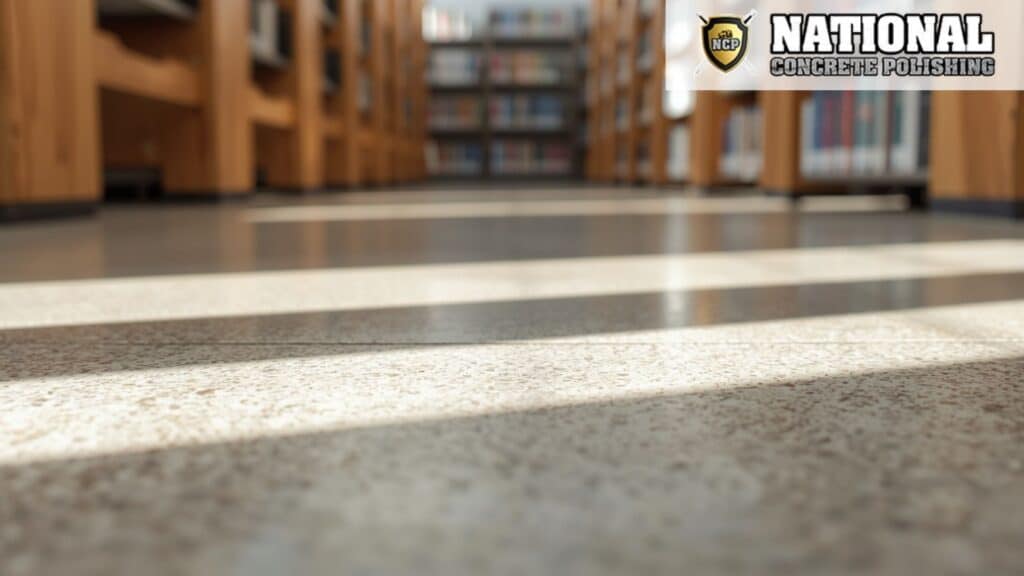
Daily maintenance of polished concrete requires only basic cleaning procedures that library staff can easily incorporate into routine operations. Unlike carpeted areas that require frequent vacuuming, polished concrete maintains its appearance through simple dust mopping.
The elimination of waxing and refinishing operations provides significant cost savings over the life of the floor. Polished concrete eliminates these requirements while providing superior appearance.
Energy cost reductions result from the light-reflecting properties of polished concrete, which amplify both natural and artificial lighting throughout library spaces. See building temperature impact.
The durability of polished concrete library flooring provides exceptional value through extended service life that can span several decades with proper maintenance.
Frequently Asked Questions
How long does polished concrete installation take in a library setting?
Installation timelines vary based on library size and existing conditions, but most projects can be completed in phases over 1-2 weeks.
Is polished concrete slippery when wet?
Properly finished polished concrete provides excellent slip resistance even when wet, meeting safety standards. See slip resistance aggregates.
Can polished concrete be installed over existing flooring?
In most cases, existing flooring must be removed. Learn floor removal techniques.
How does polished concrete perform in South Florida’s humid climate?
Polished concrete performs exceptionally well due to its non-porous, sealed surface. Check humidity impacts.
What maintenance is required for polished concrete library floors?
Daily maintenance involves simple dust mopping with periodic damp cleaning. No waxing required.
Can decorative elements be incorporated into library polished concrete?
Yes, through colored aggregates, staining, or saw-cut patterns.
How does the cost compare to other library flooring options?
Initial costs are comparable, but longevity provides superior value.
Does polished concrete emit any odors or chemicals?
Properly installed polished concrete is completely inert.
Conclusion
The selection of polished concrete for South Florida library flooring represents a strategic investment in creating optimal learning environments that serve communities for decades to come. The unique combination of acoustic control, dust-free operation, and low maintenance requirements makes polished concrete the ideal choice.
As libraries continue to evolve as community centers, the flooring foundation becomes increasingly important in supporting these expanded roles. Polished concrete provides the durability and flexibility necessary to accommodate changing uses.
The expertise of National Concrete Polishing ensures that South Florida libraries receive professional installation and ongoing support. Professional contractors understand the unique requirements of library environments.
The long-term benefits extend beyond immediate operational advantages to include environmental sustainability, energy efficiency, and enhanced property value.
source https://nationalconcretepolishing.net/polished-concrete-south-florida-library/


No comments:
Post a Comment