South Florida’s rich cultural landscape is home to numerous prestigious museums that house invaluable collections ranging from contemporary art to historical artifacts. These institutions face unique challenges when it comes to maintaining their flooring systems, particularly in preserving the delicate balance between functionality and historical sensitivity. Museums require flooring solutions that not only withstand heavy foot traffic and provide optimal display conditions but also respect the architectural integrity and historical significance of their spaces.
Concrete polishing has emerged as an increasingly popular solution for museum flooring, offering a perfect blend of durability, aesthetic appeal, and preservation-friendly characteristics. Unlike traditional flooring materials that may require frequent replacement or extensive maintenance, polished concrete provides a long-lasting foundation that can be customized to complement any museum’s unique architectural style and curatorial needs. The process involves mechanically grinding and polishing concrete surfaces to achieve varying levels of sheen and smoothness, creating floors that are both beautiful and highly functional.
The humid subtropical climate of South Florida presents additional considerations for museum flooring. High humidity levels, frequent temperature fluctuations, and the constant battle against moisture infiltration require flooring solutions that can maintain stability and performance under challenging environmental conditions. Understanding how Florida humidity impacts concrete floor finishes explains why polished concrete’s inherent resistance to moisture and its ability to work harmoniously with HVAC systems make it an ideal choice for South Florida’s museum environments.
For institutions seeking to balance historical preservation with modern functionality, concrete polishing museum applications offer unprecedented flexibility. The process can be tailored to achieve subtle, understated finishes that allow artwork and exhibits to take center stage, or it can create dramatic, high-gloss surfaces that become architectural features in their own right. This versatility makes polished concrete particularly valuable for museums that host diverse exhibitions and need flooring that can adapt to changing display requirements.
The growing recognition of polished concrete’s benefits has led many South Florida museums to consider this innovative flooring solution as they plan renovations, expansions, or new construction projects. Understanding the unique requirements and opportunities associated with museum concrete polishing is essential for making informed decisions that will serve these important cultural institutions for decades to come.
Key Takeaways
Understanding the essential aspects of concrete polishing museum applications helps museum administrators, architects, and preservation specialists make informed decisions about flooring investments. The following key points highlight the most critical considerations for South Florida museums evaluating polished concrete solutions.
- Exceptional Durability: Polished concrete offers exceptional durability and longevity, making it a cost-effective long-term investment for museums with limited maintenance budgets, as the process creates surfaces that can withstand decades of heavy foot traffic without showing significant wear.
- Environmental Control: The thermal mass properties of concrete help stabilize indoor temperatures, while the sealed surface prevents moisture migration that could affect humidity levels critical for artifact preservation, reducing strain on HVAC systems.
- Unlimited Customization: From subtle matte finishes that provide non-reflective surfaces for light-sensitive displays to high-gloss options that enhance natural lighting, the polishing process can be tailored to support each museum’s unique mission and design vision.
- Chemical Resistance: The sealed surface resists staining from spills and can be cleaned with simple, non-toxic methods that won’t compromise indoor air quality or pose risks to sensitive artifacts and visitors with chemical sensitivities.
- Low Maintenance: Unlike traditional flooring materials requiring frequent refinishing or replacement, polished concrete requires minimal maintenance, reducing operational disruption and protecting collections during construction activities.
Museum-Grade Polished Concrete Overview
Museum-grade concrete polishing represents a specialized application of traditional concrete finishing techniques, adapted to meet the unique demands of cultural institutions. This process goes far beyond standard commercial polishing, incorporating additional considerations for historical preservation, environmental control, and the specific functional requirements of exhibition spaces. The result is a flooring system that serves as both a practical foundation and an integral component of the museum’s overall preservation strategy.
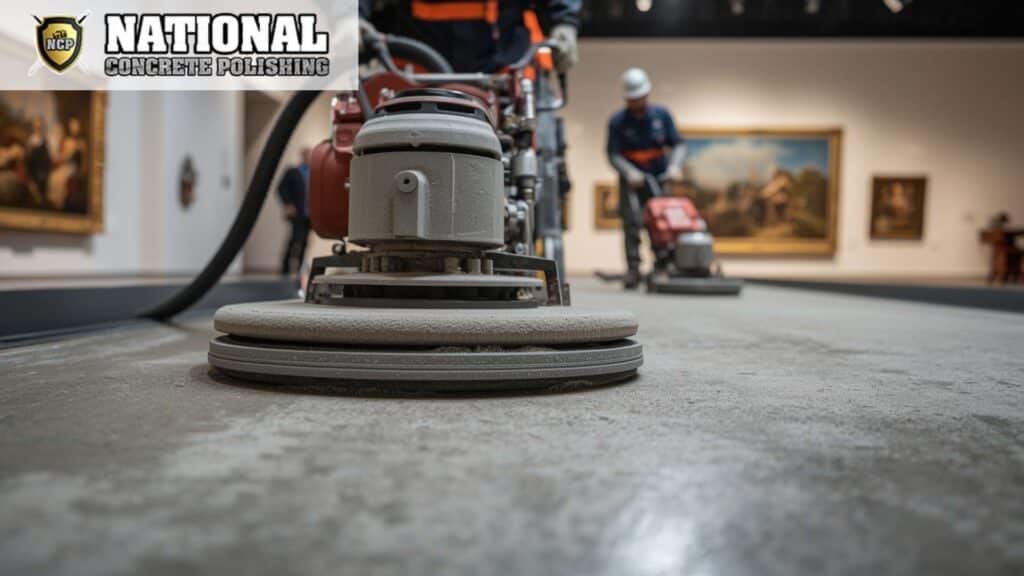
The polishing process begins with a thorough assessment of existing concrete conditions, including age, composition, and any previous treatments that might affect the final outcome. In historic buildings, this evaluation often reveals unique aggregate compositions or construction methods that can be highlighted through careful polishing techniques, similar to approaches used when professionals can polish old concrete to reveal hidden beauty. Skilled craftsmen work to preserve these historical elements while creating modern performance characteristics that meet contemporary museum standards.
Advanced diamond grinding and polishing equipment allows for precise control over surface texture and sheen levels, enabling the creation of floors that complement specific exhibition requirements. Areas designated for light-sensitive displays might receive matte finishes that minimize reflection, while circulation spaces could feature higher gloss levels that enhance wayfinding and create visual interest. Understanding polished concrete sheen levels helps museums select the ideal finish for each space.
Densification and sealing processes used in museum concrete polishing applications employ specially selected products that enhance durability while maintaining compatibility with conservation standards. These treatments penetrate deep into the concrete matrix, creating surfaces that resist wear, moisture penetration, and chemical damage without introducing materials that could off-gas harmful compounds or interfere with climate control systems. Professional contractors like those at National Concrete Polishing understand how to select appropriate densifiers for specific museum applications.
Quality control measures for museum concrete polishing projects typically exceed industry standards, with extensive testing and documentation throughout the process. This attention to detail ensures consistent results across large floor areas and provides the detailed records that many institutions require for maintenance planning and historical documentation purposes.
Preservation for Historic Buildings
Historic museum buildings present unique challenges and opportunities when implementing concrete polishing projects. Many of South Florida’s most prestigious cultural institutions occupy structures with significant architectural and historical value, requiring specialized approaches that preserve original design intent while incorporating modern performance standards. Successfully navigating these preservation considerations demands deep understanding of both historical construction methods and contemporary conservation principles.
Original concrete formulations in historic buildings often contain unique aggregate compositions, cement types, or construction techniques that differ significantly from modern standards. These variations can actually enhance the aesthetic appeal of polished floors, revealing beautiful aggregate patterns, color variations, and textures that reflect the building’s historical period. Skilled polishing contractors work to highlight rather than obscure these historical elements, creating floors that tell the story of the building’s construction while providing modern functionality.
Structural considerations play a crucial role in historic building concrete polishing projects. Older concrete may have different load-bearing characteristics, expansion joint configurations, or foundation systems that require specialized approaches, and understanding how concrete age affects polishing results helps ensure successful outcomes. Professional assessment of structural conditions ensures that polishing processes enhance rather than compromise the building’s integrity, while identifying opportunities to reinforce or stabilize areas that might benefit from modern treatment methods.
Compatibility with existing building systems represents another critical preservation consideration. Historic HVAC systems, electrical installations, and plumbing configurations may limit access for polishing equipment or require special coordination to prevent damage during construction activities. Experienced contractors develop detailed project plans that work around these constraints while achieving optimal results for the flooring installation.
Documentation requirements for historic preservation projects typically exceed those of standard commercial installations. Detailed photographic records, material testing results, and process documentation help satisfy regulatory requirements while creating valuable historical records for future maintenance and renovation planning. This comprehensive documentation also supports grant applications and preservation funding requests that many historic museums rely upon for major building improvements.
Climate Control and Environmental Benefits
South Florida’s challenging climate conditions make environmental control a critical consideration for museum operations, and polished concrete flooring provides significant advantages in maintaining the stable conditions essential for artifact preservation. The unique thermal and moisture management properties of properly polished concrete create a foundation that actively supports rather than hinders climate control efforts, resulting in improved environmental stability and reduced operational costs.
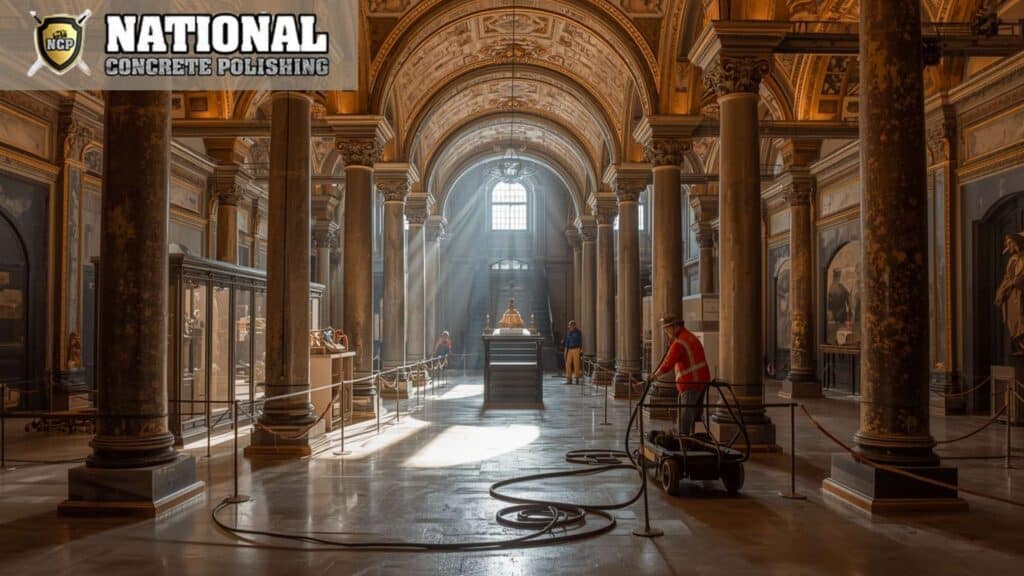
Thermal mass characteristics of concrete floors help moderate indoor temperature fluctuations by absorbing and slowly releasing heat energy throughout daily temperature cycles. This natural temperature buffering reduces the workload on HVAC systems, particularly during South Florida’s extreme summer months when outdoor temperatures can exceed 90 degrees Fahrenheit with high humidity levels. Learning how polished concrete affects building temperature demonstrates these benefits in Florida’s climate.
Moisture management represents perhaps the most critical environmental benefit of polished concrete in South Florida museum applications. The region’s high humidity levels and frequent rainfall create constant challenges for maintaining proper indoor moisture levels, typically between 45-55% relative humidity for most museum collections. Polished concrete’s sealed surface prevents moisture migration from the ground through the floor slab, eliminating a major source of humidity infiltration that can overwhelm climate control systems and threaten sensitive artifacts.
Air quality improvements result from polished concrete’s resistance to dust generation and its compatibility with low-impact cleaning methods. Traditional flooring materials often require chemical cleaners, waxes, or other treatments that can introduce volatile organic compounds (VOCs) into the museum environment. Understanding proper concrete polishing dust control systems shows how modern techniques maintain pristine air quality.
Energy efficiency benefits extend beyond direct HVAC savings to include improved lighting performance and reduced maintenance energy consumption. The reflective properties of polished concrete can be optimized to enhance natural lighting distribution, reducing artificial lighting requirements during daytime hours. Additionally, the longevity and low maintenance requirements of polished floors eliminate the energy consumption associated with frequent floor refinishing, replacement, and the manufacturing and transportation of replacement materials.
Aesthetic Integration with Museum Design
The aesthetic integration of polished concrete flooring with museum design requires careful consideration of how floor surfaces interact with lighting, exhibit displays, and overall architectural themes. Successful concrete polishing museum projects achieve seamless integration that enhances rather than competes with the institution’s curatorial mission and design vision. This integration process involves collaboration between flooring specialists, museum designers, curators, and preservation professionals to create cohesive environments that support diverse exhibition requirements.
Color and aggregate selection provide opportunities to create custom floor appearances that complement specific architectural styles or institutional branding. South Florida’s diverse cultural institutions range from contemporary art museums with minimalist design aesthetics to historical societies housed in restored period buildings. Polished concrete can be customized to support any design direction through careful selection of cement colors, decorative aggregates, and finishing techniques, similar to how professionals control aggregate exposure for optimal results.
Sheen level optimization plays a crucial role in supporting different exhibition types and lighting schemes. Contemporary art galleries often benefit from matte or low-gloss finishes that minimize reflections and glare, allowing visitors to focus entirely on displayed artworks without visual distractions from floor surfaces. Conversely, circulation areas, lobbies, and special event spaces may feature higher gloss levels that enhance lighting efficiency and create dramatic visual impact while supporting wayfinding and crowd flow management.
Pattern and design integration capabilities of modern concrete polishing allow for the incorporation of custom elements that support museum branding or historical themes. Techniques such as saw-cutting decorative patterns, incorporating contrasting aggregates in specific areas, or creating subtle color variations can add visual interest while maintaining the sophisticated appearance appropriate for cultural institutions. These design elements can also serve functional purposes such as defining circulation paths or creating visual transitions between different gallery spaces.
Lighting interaction considerations are particularly important in museum environments where carefully controlled illumination is essential for both artifact preservation and visitor experience. Polished concrete’s reflective properties can be precisely calibrated to support specific lighting schemes, and understanding how concrete reflectivity is measured helps achieve desired photometric performance. Professional lighting designers often specify particular sheen levels and surface textures to achieve desired results.
Technical Specifications and Installation
Technical specifications for museum concrete polishing projects must address both standard performance requirements and the specialized needs of cultural institutions. These specifications typically exceed commercial standards in areas such as surface flatness, chemical resistance, and environmental compatibility. Understanding these technical requirements helps ensure successful project outcomes that meet both immediate performance needs and long-term preservation goals.
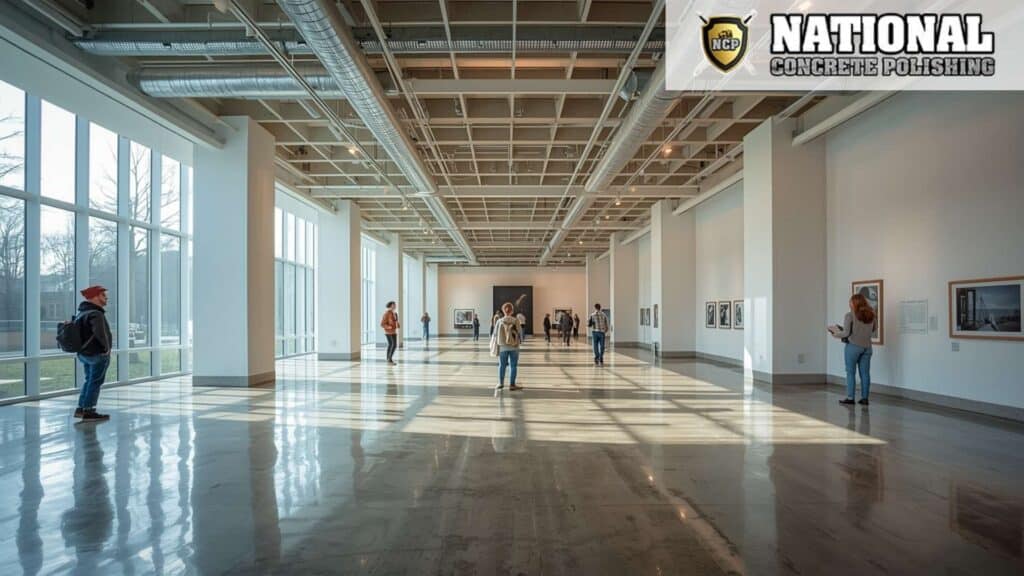
Surface preparation requirements for museum concrete polishing begin with comprehensive evaluation of existing slab conditions, including flatness, levelness, and structural integrity. Museum floors often need to meet higher flatness standards than typical commercial applications to support precise exhibit installation and prevent water pooling that could damage artifacts. Professional assessment may reveal the need for remedial work, and understanding concrete surface profile (CSP) requirements ensures proper preparation.
Diamond tooling selection and progression sequences are carefully planned to achieve specified surface characteristics while preserving any desirable historical features within the concrete. The grinding and polishing process typically progresses through multiple stages, beginning with coarse diamond tools to remove surface imperfections and gradually advancing to finer grits that create the desired finish quality. Learning about diamond grinding pad progression reveals the technical precision involved.
Densification and sealing protocols for museum installations employ specially selected products that enhance performance while meeting strict environmental and preservation standards. Penetrating densifiers increase surface hardness and reduce porosity, while topical sealers may be applied to provide additional protection against staining or chemical damage. Product selection considers factors such as VOC content, compatibility with existing materials, and long-term stability under museum environmental conditions.
Quality control measures throughout the installation process include extensive testing and documentation to verify compliance with project specifications. Surface hardness testing, moisture vapor emission testing, and photometric measurement of gloss levels provide objective verification of performance characteristics. Visual inspection protocols ensure consistent appearance across large floor areas, while detailed documentation creates valuable records for future maintenance planning.
Maintenance and Long-Term Care
Developing comprehensive maintenance and long-term care strategies for polished concrete in museum environments ensures optimal performance throughout the floor’s service life while minimizing disruption to museum operations. These strategies must balance the need for preserving floor appearance and functionality with the institution’s requirements for maintaining stable environmental conditions and protecting valuable collections from construction-related risks.
Daily maintenance protocols for museum polished concrete focus on simple, effective cleaning methods that preserve surface integrity while meeting the cleanliness standards expected by visitors and required for artifact preservation. Dust mopping with microfiber tools removes surface debris without scratching, while damp mopping with pH-neutral cleaners addresses more significant soiling without introducing harmful chemicals into the museum environment. These routine maintenance activities can typically be performed by existing custodial staff with minimal additional training.
Periodic maintenance procedures address deeper cleaning needs and minor surface restoration requirements that may develop over time. Quarterly or semi-annual deep cleaning using auto-scrubbers with appropriate pad selection removes accumulated soiling and restores surface luster. Annual inspection and spot treatment of high-wear areas helps identify potential issues before they require major intervention, maintaining consistent appearance across the entire floor area.
Long-term restoration planning anticipates the eventual need for surface renewal after years of service, even with excellent maintenance practices. Polished concrete floors in museums may require repolishing every 10-15 years, depending on traffic levels and maintenance quality, and understanding how to extend polished concrete lifespan helps maximize service life in coastal South Florida. Planning for these major maintenance events includes budgeting considerations, scheduling around major exhibitions, and developing protocols for protecting collections during restoration activities.
Environmental monitoring integration helps optimize maintenance schedules and identify potential issues before they affect floor performance or museum operations. Humidity and temperature logging can reveal patterns that might accelerate floor aging or indicate the need for adjusted maintenance frequencies. Integration with existing building management systems provides valuable data for optimizing both floor care and overall facility operations.
Frequently Asked Questions
How long does the concrete polishing process take in a museum setting?
The timeline for concrete polishing museum projects varies significantly based on floor area, existing conditions, and institutional requirements. Typical projects range from 2-6 weeks, with larger museums or those requiring extensive surface preparation potentially taking longer. Museums often prefer scheduling during closure periods or off-seasons to minimize visitor disruption.
Can polished concrete damage sensitive artifacts or exhibits?
Properly executed concrete polishing projects use advanced dust collection systems and environmental controls that prevent contamination of museum spaces. Professional contractors experienced in museum work understand the critical importance of maintaining clean conditions and will implement comprehensive protection measures throughout the installation process.
What maintenance is required for polished concrete in museums?
Museum polished concrete requires minimal daily maintenance, typically involving dust mopping and occasional damp cleaning with pH-neutral products. Annual deep cleaning and periodic inspection help maintain optimal appearance and performance. Major repolishing may be needed every 10-15 years depending on traffic levels.
How does polished concrete affect museum climate control systems?
Polished concrete actually supports climate control efforts by providing thermal mass that moderates temperature fluctuations and preventing moisture migration through the floor slab. This can result in more stable environmental conditions and reduced HVAC operating costs, both critical benefits for museum operations.
Is polished concrete appropriate for historic museum buildings?
Polished concrete can be an excellent choice for historic museums when properly specified and installed. The process can highlight original aggregate compositions and construction details while providing modern performance characteristics. Preservation specialists should be consulted to ensure compatibility with historic preservation requirements.
What are the cost considerations for museum concrete polishing?
While initial installation costs may be higher than some alternatives, polished concrete provides exceptional long-term value through reduced maintenance requirements and extended service life, and understanding polished concrete costs helps with budget planning. Museums should consider total lifecycle costs when evaluating flooring options, including energy savings from improved thermal performance.
Can polished concrete be customized to match museum design themes?
Concrete polishing offers extensive customization options including color selection, aggregate exposure, pattern integration, and varying sheen levels. These capabilities allow for seamless integration with any museum design aesthetic while maintaining the performance characteristics essential for institutional applications.
How does National Concrete Polishing ensure quality in museum projects?
National Concrete Polishing brings specialized expertise in museum and institutional applications, understanding the unique requirements of cultural institutions. Their experienced team works closely with museum administrators, architects, and preservation specialists to deliver results that meet both performance and aesthetic requirements while respecting the institution’s mission and operational needs.
Conclusion
The implementation of concrete polishing museum solutions in South Florida represents a sophisticated approach to balancing preservation, functionality, and aesthetic excellence in cultural institutions. As museums continue to evolve and adapt to changing visitor expectations and conservation requirements, polished concrete flooring provides a foundation that supports these diverse needs while offering exceptional long-term value and performance.
The unique advantages of polished concrete in museum environments extend far beyond simple durability and appearance. The climate control benefits, environmental compatibility, and customization capabilities make this flooring solution particularly well-suited to South Florida’s challenging environmental conditions and the region’s diverse cultural institutions. From contemporary art galleries to historic house museums, polished concrete can be tailored to support each institution’s unique mission and design vision, similar to how it serves retail stores with high foot traffic and other demanding applications.
National Concrete Polishing’s expertise in museum and institutional applications ensures that these specialized projects receive the attention to detail and technical precision they require. Their understanding of preservation principles, environmental requirements, and the operational needs of cultural institutions makes them an ideal partner for museums considering polished concrete flooring solutions.
The long-term benefits of museum-grade concrete polishing create value that extends throughout the floor’s service life, supporting institutional sustainability goals while providing the stable, attractive foundation that world-class museums demand. As South Florida’s cultural landscape continues to grow and evolve, polished concrete flooring will undoubtedly play an increasingly important role in creating spaces that preserve our shared heritage while inspiring future generations of museum visitors.
source https://nationalconcretepolishing.net/concrete-polishing-museum/


No comments:
Post a Comment